The DOE Completely Changed Their SBIR Requirements

The Department of Energy moved SBIR/STTR under the Office of Technology Commercialization. This is no longer just a research grant — it's a commercialization engine. Here are the 9 changes every energy and climate tech founder needs to understand.
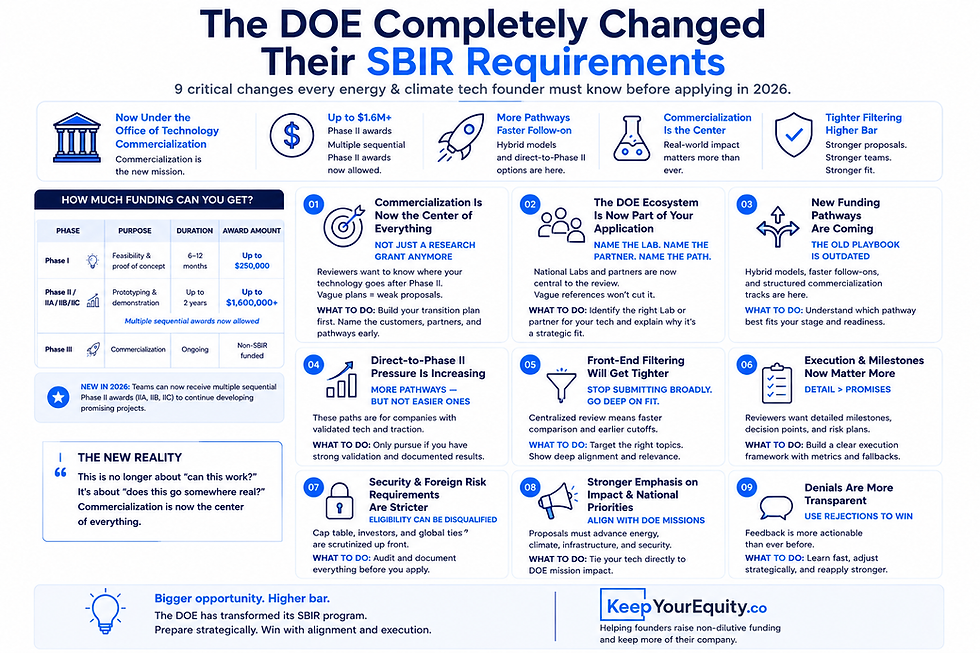
The U.S. Department of Energy has consolidated SBIR/STTR management under the Office of Technology Commercialization — and the implications for founders are significant. This isn't a minor administrative change. It signals a fundamental shift in what DOE is looking for, how proposals are evaluated, and what it takes to win. Climate tech, energy systems, AI, quantum, and semiconductor founders who apply under the old assumptions will get filtered out fast. There is more SBIR funding available than ever, with award ceilings now updated. But the bar has moved up and the filtering is tighter. Below are the 9 changes that will define the new DOE SBIR landscape for 2026 and beyond.
BEFORE YOU APPLY
This is not the same DOE SBIR program. Commercialization requirements, review criteria, ecosystem expectations, and milestone standards have all changed significantly. Founders who approach this cycle the same way as previous years will get filtered out before they're even seriously considered.
How Much Funding Can You Actually Get?
Before the changes: here are the updated 2026 funding amounts from the official DOE program page.
PHASE | PURPOSE | DURATION | AWARD AMOUNT |
Phase I | Feasibility & proof of concept | 6–12 months | Up to $250,000 |
Phase II / IIA / IIB / IIC | Prototyping & demonstration | Up to 2 years | Up to $1,600,000 Multiple sequential awards now allowed |
Phase III | Commercialization | Ongoing | Non-SBIR funded |
NEW IN 2026
Teams can now receive multiple sequential Phase II awards (IIA, IIB, IIC) to continue developing promising projects. This is a significant structural change that creates a longer runway for companies with strong traction — and rewards those who build sustained relationships with DOE and the National Lab system.
"This is no longer about 'can this work?' It's about 'does this go somewhere real?' Commercialization is now the center of everything."
9 Changes That Define the New DOE SBIR Landscape
01 Commercialization Is Now the Center of Everything NOT JUST A RESEARCH GRANT ANYMORE | |
DOE's consolidation under the Office of Technology Commercialization is not just an administrative move. It is a signal about what matters most. The program's explicit mission is now to move taxpayer-funded research toward real-world commercial impact. Interesting science alone is no longer sufficient justification. | |
Every section of your proposal will now be read through the lens of: where does this go after Phase II? If you can't answer that question concretely and early in the document, reviewers will treat your application as underprepared — regardless of how strong the underlying science is. | |
WHAT TO DO Build your transition plan first, before writing any other section. Define where your technology lands after Phase II — named customers, deployment partners, or follow-on pathways. If that plan is vague, everything else is undermined. |
02 The DOE Ecosystem Is Now Part of Your Application NAME THE LAB. NAME THE PARTNER. NAME THE PATH. | |
National Labs, intermediaries, and commercialization partners are being pulled into one unified system under OTC. Reviewers will be evaluating how explicitly you connect to that ecosystem in your proposal. | |
Vague references to 'leveraging DOE resources' are now a weakness, not a strength. Reviewers are looking for specificity: which lab, which partner, which pathway, and why that connection is credible given your technology and stage. | |
WHAT TO DO Research which National Lab or DOE partner is the natural home for your technology before you write. Name them explicitly in your proposal and explain why that relationship is strategically meaningful — not just available. |
03 New Funding Pathways Are Coming THE OLD PHASE I TO PHASE II PLAYBOOK IS OUTDATED | |
The DOE is introducing hybrid models, faster follow-on mechanisms, and more structured commercialization tracks. The linear Phase I to Phase II pathway is no longer the only route — and in many cases, not the most advantageous one for well-positioned companies. | |
Founders who assume the old playbook still applies will miss emerging opportunities to accelerate through the funding structure. The key is understanding which pathway fits your technology's current stage and commercial readiness. | |
WHAT TO DO Don't assume you know the pathway before reviewing updated program guidance. Position yourself based on where your technology can realistically go next — not just how to get through the door via the most familiar route. |
04 Direct-to-Phase II Pressure Is Increasing MORE PATHWAYS — BUT NOT EASIER ONES | |
Yes, more direct-to-Phase II pathways exist in the new structure. No, that does not mean it's easier to skip Phase I. The direct pathway is designed for companies that have already validated their technology and demonstrated meaningful traction. | |
Founders who pursue direct-to-Phase II without the appropriate foundation are not just likely to be rejected — they're skipping structured development steps that build the credibility that makes Phase II competitive in the first place. | |
WHAT TO DO Only pursue direct-to-Phase II if you already have validation, demonstrated performance data, and documented traction. Otherwise, Phase I is not a slower path — it's the right one. |
05 Front-End Filtering Will Get Tighter STOP SUBMITTING BROADLY. GO DEEP ON FIT. | |
Centralization under OTC means DOE can now make direct, systematic comparisons across applications. This tightens the front-end filter significantly — 'maybe' bets get cut earlier, and the competition for funded slots becomes more direct. | |
Broad, low-fit submissions no longer slip through on volume. Reviewers are operating with more context about the full competitive landscape, which means a proposal that would have cleared the bar previously may now be filtered out before serious evaluation. | |
WHAT TO DO Identify the one or two topic areas where your technology has the strongest fit and go deep — tailoring every element of the proposal to that specific program area and its current priorities. |
06 Review Timelines Are Moving Faster WAITING UNTIL TOPICS DROP PUTS YOU BEHIND IMMEDIATELY | |
DOE has explicitly optimized the new OTC-managed structure for speed and operational efficiency. Review timelines are expected to compress compared to previous cycles — which creates a real preparation problem for founders who rely on the release of topics to start thinking about their application. | |
If your preparation process starts when the topics drop, you are already behind the founders who built their positioning, assembled their teams, and refined their commercialization narrative in advance. | |
WHAT TO DO Be fully prepared before topics drop. Your technical narrative, commercialization plan, team structure, and National Lab connections should already be in place when you see the solicitation — not built in response to it. |
07 Stronger Emphasis on Measurable Outcomes MILESTONES NEED TO SHOW PROGRESS TOWARD DEPLOYMENT | |
Milestones in a DOE SBIR proposal are no longer purely technical. Reviewers are now evaluating whether your milestones demonstrate progress toward real-world deployment — not just scientific advancement. A technically rigorous plan that doesn't connect to deployment-relevant outcomes will be seen as incomplete. | |
Your go/no-go criteria need to address both technical readiness and commercial viability signals. Founders who define success purely in terms of laboratory performance metrics are leaving significant evaluation points on the table. | |
WHAT TO DO Define clear, quantitative go/no-go metrics explicitly tied to real-world use. At least some of your milestones should reflect progress toward deployment, adoption, or commercial validation — not just technical performance thresholds. |
08 National Priorities Matter More Than Ever POSITION WITHIN A NATIONAL PROBLEM, NOT JUST A TECHNICAL SOLUTION | |
DOE's 2026 priority areas are explicit: AI, quantum computing, semiconductors, energy systems, and critical materials. These reflect where DOE is directing evaluation weight when comparing otherwise competitive applications. A strong proposal that doesn't connect to one of these priority areas starts at a disadvantage. | |
The goal isn't to shoehorn your technology into a national priority it doesn't belong in. It's to articulate, genuinely and specifically, why the problem your technology solves matters at a national scale. | |
WHAT TO DO Identify which national priority your work most genuinely serves and build that framing into your proposal from the opening paragraph. 'This matters for energy security because...' should appear early and clearly — not buried in the background section. |
09 Multiple Sequential Phase II Awards Are Now Possible A LONGER RUNWAY FOR COMPANIES THAT PROVE THEMSELVES | |
Teams can now receive multiple sequential Phase II awards — IIA, IIB, and IIC — to continue developing promising projects beyond what a single award could support. This fundamentally changes the funding horizon for companies with strong technical progress and clear commercial trajectories. | |
DOE is signaling a willingness to back companies through a longer development arc, not just fund a discrete project. But sequential Phase II funding is earned through demonstrated execution on prior milestones and sustained commercial relevance — it is not automatic. | |
WHAT TO DO Plan your development roadmap with the sequential Phase II structure in mind from the beginning. Your Phase IIA proposal should plant the seeds for IIB — building the narrative of a company on a credible, funded trajectory, not a single-project applicant. |
| THE BOTTOM LINE FOR CLIMATE & ENERGY FOUNDERS More funding is available, the runway is longer, and the program is now purpose-built around commercialization. But the bar is higher and the filtering is tighter. The founders who win in this new DOE landscape treat commercialization as their first consideration — not their last — and build proposals around named customers, specific National Lab connections, and deployment-relevant milestones from the very first section. |
Frequently Asked Questions
How much does the DOE SBIR program pay in 2026?
Phase I awards are up to $250,000 for 6–12 months of feasibility work. Phase II/IIA/IIB/IIC awards go up to $1.6 million over up to 2 years. Multiple sequential Phase II awards are now available for promising projects. Phase III is non-SBIR funded and covers commercialization work that derives from prior Phase I and II efforts.
What is the DOE Office of Technology Commercialization SBIR program?
The DOE recently consolidated management of its SBIR and STTR programs under the Office of Technology Commercialization (OTC). This reflects DOE's focus on moving taxpayer-funded research toward real-world commercial impact, streamlining innovation pathways, and strengthening engagement between small businesses and the DOE National Laboratory system.
What are the DOE SBIR priority areas for 2026?
DOE SBIR in 2026 is aligned with national priorities including AI, quantum computing, semiconductors, energy systems, and critical materials. Proposals that position their technology within one of these national problem areas — rather than purely as a technical solution — are at a significant advantage in review.
Can you go directly to Phase II in the DOE SBIR program?
Direct-to-Phase II pathways exist, but they are not easier than the standard Phase I route. They are designed for companies that already have validated technology and demonstrated traction. Skipping Phase I without that foundation means bypassing steps that build the credibility needed for a competitive Phase II application.
What changed about DOE SBIR review timelines in 2026?
DOE has explicitly optimized for speed and efficiency in the new OTC-managed structure. Review timelines are expected to compress. Founders should be fully prepared before topics drop — waiting until the release date puts you immediately behind well-prepared competitors.
How do DOE National Labs factor into SBIR applications?
Under the new OTC-managed structure, National Labs, intermediaries, and commercialization partners are integrated into a single system. Applicants are expected to explicitly name the lab, partner, or pathway they connect to. Vague or generic references to 'the DOE ecosystem' are treated as a weakness — specificity is expected and rewarded.


Comments